Sign up today to get the latest news and updates from EPC on new product announcements, applications work, and much more. Sign up for EPC email updates.
EPC2361 eGaN® FETs deliver high-current, low-loss switching in a 36 V to 65 V input, 48 V output platform.
EL SEGUNDO, Calif. – October 20, 2026 – Efficient Power Conversion (EPC), the world leader in enhancement-mode gallium nitride (eGaN®) power devices, today announced the use of its EPC2361 100 V eGaN FETs in a high-performance buck-boost converter reference design from Analog Devices, Inc. (ADI).
The design demonstrates how GaN technology can enable efficient, high-current power conversion for demanding industrial, telecom, battery charging, and other high-power applications.
Read more
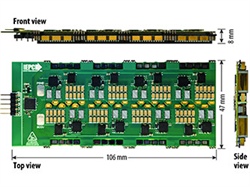
Michael De Rooij of EPC presents low-voltage GaN architectures for converting 800 V to 50 V, 12 V, and 6 V in server power systems. The talk highlights an input-series, output-parallel (ISOP) topology that distributes heat, reduces ripple and EMI, and simplifies transformer design. Demonstrated converters include an 11 kW, 800-to-50 V unit and a 6 kW, 800-to-12 V design with eight series input modules and eight parallel outputs. A 6 V example illustrates high-efficiency GaN devices and power-dense server conversion.
Read more
Alejandro Pozo, Director of Applications Engineering at Efficient Power Conversion
Artificial intelligence (AI) computing, robotics, autonomous machines, and industrial automation are driving demand for smaller, more efficient power electronic converters. With conventional silicon (Si) MOSFETs, engineers have traditionally faced a trade-off between efficiency and power density, as the higher switching frequencies required to reduce converter size typically result in increased switching losses and lower overall efficiency. Recent gallium nitride (GaN) products have largely eliminated this compromise by enabling both higher switching frequencies and higher efficiency [1]. As a result, power converters can achieve greater power density without sacrificing performance. Today, 48 V systems are ubiquitous in AI server racks, humanoid robots, drones, automotive electronics, and industrial equipment. Consequently, 80 to 100 V-rated devices have become key building blocks in the power conversion systems present in these applications.
Read more
Gallium nitride (GaN) power devices are rapidly transitioning from an emerging technology to a critical component enabling high-efficiency power conversion. As applications such as AI infrastructure, data centers, robotics and electrification demand higher efficiency, higher power density and faster switching, how GaN devices are tested is becoming more and more important.
To learn how semiconductor testing is changing with GaN technology, Accotest’s Global Marketing Director Huipeng Liu was interviewed. Accotest is a leading automated test equipment (ATE) manufacturer with extensive experience in semiconductor production testing.
Read more

Visit EPC at Hall C6, Booth 221, November 10–13 in Munich, to explore its latest GaN solutions for emerging applications
EL SEGUNDO, Calif. – October 1, 2026 – Efficient Power Conversion (EPC), a leader in enhancement-mode gallium nitride (eGaN®) power devices, will showcase its latest eGaN® FETs, integrated power stages and reference designs at electronica 2026, November 10–13 in Munich, Germany. At Hall C6, Booth 221, EPC will demonstrate how GaN technology is enabling smaller, lighter, faster and more efficient power systems for emerging applications including artificial intelligence, physical AI, robotics, autonomous machines and space electronics.
A key focus will be the role of GaN in the rapidly evolving AI power infrastructure. EPC will demonstrate solutions spanning the power-delivery chain, from 800 VDC distribution to point-of-load conversion, including the EPC91123 6 kW 800 V-to-12.5 V ISOP LLC converter and a new 6 kW 800 V-to-6 V converter designed to bring high-voltage power closer to next-generation AI processors.
Read more
EPC demonstrates a 6 kW GaN platform spanning 800 V to core voltage. An ISOP stage converts 800 V to 6 V, followed by a monolithic GaN buck converter switching at 5 MHz and delivering 0.9 V at 11 A.
Read more
By Diego de Azcuénaga
The architecture of power management systems for spaceborne platforms demands semiconductor devices capable of operating deterministically under continuous ionizing radiation fluxes. In traditional space-grade LDO linear regulators, silicon MOSFETs serve as the primary pass element. However, prolonged exposure to TID induces the generation of electron-hole pairs within the gate dielectric of these devices. Holes trapped at the oxide interface shift the threshold voltage (Vth) and irreversibly degrade transconductance (gm), typically by magnitudes exceeding 20%. This parametric degradation introduces severe non-linearities into the analog feedback loop, forcing designers to incorporate over-dimensioned design margins or complex dynamic compensation networks to prevent control loop oscillation or voltage hunting over the mission lifespan.
Read more
By Maurizio Di Paolo Emilio, Marcom Director, EPC
Artificial intelligence is creating a new generation of data centers. It’s not just about cramming more computing into a rack anymore. It delivers hundreds of kilowatts, and ultimately megawatts to that rack in an efficient, reliable way with a practical physical footprint.
The scale of the transformation is becoming apparent. NVIDIA is creating an 800 VDC power architecture for AI infrastructure that can handle 1 MW racks and above. New projects are being announced at multi-gigawatt scale. OpenAI, for example, has locked in some 8 GW of IT capacity at the PORTS-Pike Technology Campus in Ohio, with the first capacity expected to be brought online later this decade.
Read more
By Maurizio Di Paolo Emilio, Marcom Director, EPC
Gallium nitride (GaN) power technology is entering a new phase. After gaining traction in fast chargers, automotive power conversion, and other higher-voltage applications, GaN devices rated at 40 V and below are opening a new competitive front against silicon MOSFETs. According to Paul Pickering, Research Director at Omdia, low-voltage GaN could become one of the most disruptive developments in power semiconductors over the next several years.
Read more
New technical papers examine 800 VDC power delivery for AI infrastructure and integrated
100 V GaN power stages for robotics, drones, and precision motion control
EL SEGUNDO, Calif. – September 14, 2026 – Efficient Power Conversion (EPC), a leader in enhancement-mode gallium nitride (eGaN®) power devices, today announced the publication of two new technical white papers addressing critical power-conversion challenges in two rapidly evolving markets: AI data centers and high-performance multi-axis motor drives.
Read more
By Maurizio Di Paolo Emilio, Marcom Director, and Marco Palma, Vice President of Motor Drive Marketing and System Engineering at Efficient Power Conversion, EPC
Rapid growth in industrial automation, collaborative robots, autonomous mobile robots (AMRs), drones, and precision servo systems is driving the need for a new generation of low-voltage motor drives to deliver higher efficiency, greater power density, and improved dynamic performance. In the past, silicon MOSFETs were the most common switching technology for this voltage range, but nowadays, gallium nitride (GaN) power devi
Read more
In this interview on EEPower, we learn about EPC’s Gen 8 GaN platform for AI power delivery and Trinity motor control—on display this week at PCIM Asia—to address rising power and space demands in AI and robotics.
As power demands rise across artificial intelligence, robotics, and autonomous machines, gallium nitride (GaN) is moving into applications that were once dominated by silicon. At PCIM Asia in Shenzhen, Efficient Power Conversion (EPC) is showcasing two technologies aimed at this transition: its next-generation Gen 8 GaN platform for AI power delivery and Trinity, an integrated three-phase GaN solution for motor control.
Read more
The EPC91132 reference design integrates GaN power stage, sensing, protection, and feedback for robotic and drone motor drives.
The next-generation humanoid robots and drones need motor drives to move closer to the actuator and share space with mechanical structures and sensors. They still have to deliver high current, fast control response, and reliable protection.
EPC91132 addresses this integration problem with a compact three-phase BLDC motor-drive inverter reference design based on the EPC33110 GaN three-phase module. Its core inverter can be reduced to a 23-mm diameter form factor. The company reports 11 ARMS continuous current per phase for humanoid robotic joint applications at 48 V and switching frequencies up to 100 kHz.
Read more
The ultra-low 0.28 mΩ eGaN® FET has a transient voltage rating of 22 V enabling higher efficiency, 1 MHz or higher switching, and increased power density for advanced high-current DC-DC converters.
EL SEGUNDO, Calif. – August 20, 2026 – Efficient Power Conversion (EPC), a leader in enhancement mode gallium nitride (eGaN®) power devices, today announced the mass production of the EPC2370, an ultra-low on-resistance 18 V eGaN® FET engineered to enhance the efficiency and power density of next-generation AI server power supplies. The EPC2370 has a 22 V transient voltage rating that allows it to replace MOSFETs with ratings as high as 25 V.
Read more
The rapid increase in AI computing performance is forcing a fundamental redesign of data center power architectures, with gallium nitride (GaN) emerging as a key technology for meeting the industry’s escalating efficiency and power density requirements.
Speaking during the EE Power Asia 2026 Spark Session, Dr. Alex Lidow, CEO of Efficient Power Conversion (EPC), and Jason Zhang, VP of DC/DC Marketing and System Engineering at EPC, outlined why conventional silicon power devices are approaching their practical limits as GPU power consumption continues to climb.
According to Zhang, AI accelerators have experienced a fourfold increase in power consumption across three GPU generations. Within the next two years, individual GPUs are expected to dissipate as much as 5kW while operating at core voltages below 1V, requiring current levels approaching 10,000A.
Read more
Maurizio Di Paolo Emilio, Marcom Director, EPC
Rapid growth of artificial intelligence is forcing a rethink of data-centre power architectures. Legacy server designs were never intended to support the extreme power densities of modern AI workloads. These facilities are increasingly becoming what we might call “AI factories” where the primary goal is to optimize compute capability in a constrained physical footprint.
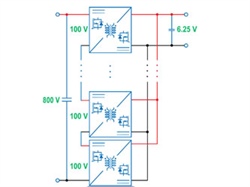
A key enabler for this transition is the use of 800 VDC distribution. The high voltage approach enables power scaling at the rack level from conventional levels to the megawatt range, which is essential for next generation accelerator platforms. 800 V direct power delivery to compute subsystems introduces new challenges in insulation coordination and device stress, but it also presents an opportunity to rethink how isolation is implemented. Here, Input-Series Output-Parallel (ISOP) converter topologies are becoming popular because of their modularity, scalability and efficiency.
Read more
By Jason Zhang, Vice President of DC-DC Marketing and System Engineering, EPC
Power delivery has become a critical design challenge in AI data centers. As GPU power requirements continue to increase, designers face growing demands to improve power conversion efficiency while reducing converter size and thermal losses. These requirements are driving the adoption of wide-bandgap semiconductor technologies, particularly gallium nitride (GaN), in the intermediate bus conversion stages of modern AI power architectures.
In this context, Efficient Power Conversion (EPC) has introduced the EPC2378, a 25 V GaN FET, and the EPC2370, an 18 V GaN FET. Both are part of the company's latest Gen 7 product family, optimized for secondary-side synchronous rectification in high-current DC-DC converters. The EPC2378 features a typical RDS(on) of 410 µΩ and a gate charge of 34 nC, while the EPC2370 offers a typical RDS(on) of 280 µΩ and a gate charge of 26 nC. Both devices are housed in a compact, thermally enhanced 3.3 × 3.3 mm PQFN package with an exposed substrate that supports dual-sided cooling. In addition to minimizing conduction losses, the devices are designed with low gate charge to reduce switching losses at a switching frequency of 1 MHz, improving overall efficiency and power density.
Read more
Latest eGaN FETs, integrated power stages and evaluation boards enable Gen7 power delivery from 800 VDC to Point-of-Load, and the advanced monolithic GaN power stages enable higher efficiency and smaller size and weight in robots and drones.
EL SEGUNDO, Calif. - July 20, 2026 — Efficient Power Conversion (EPC), the world’s leader in enhancement-mode gallium nitride (GaN)–based power solutions, will showcase the company’s newest generation GaN technology at PCIM Asia 2026, taking place August 26–28 in Shenzhen, China (Hall 16, Booth B03). At the show, EPC will demonstrate how its Gen7 GaN platform enables compact, high-performance power architectures for intelligent motion control and AI power delivery. The latest generation of eGaN® devices combines ultra-low on-resistance, low switching losses, and high-frequency operation to simplify system integration while improving efficiency, dynamic response, and thermal performance.
Read more
Industry Keynote Highlights AI-Driven Power Trends, 800 VDC Architectures, and GaN Innovation
EL SEGUNDO, Calif. - July 14, 2026, – Efficient Power Conversion (EPC), the world’s leader in enhancement-mode gallium nitride (GaN)–based power solutions, will participate in Tech Taipei Power 2026, one of Taiwan's premier power electronics conferences, bringing together industry experts to discuss the latest advances in power conversion technologies for AI infrastructure, industrial systems, automotive, robotics, and next-generation energy applications.
Read more