The Future Prospects for GaN Technology
GaN Talk – Renee Yawger
Oct 09, 2025
As artificial intelligence (AI), robotics, and space systems redefine what’s possible in power electronics, gallium nitride (GaN) technology continues to lead the transformation. In a recent interview with Electronic Product Design & Test (EPDT), Dr. Alex Lidow, CEO and co-founder of EPC, shared his perspective on how GaN is reshaping the semiconductor landscape — and what’s next for this fast-evolving technology.
AI and Robotics: GaN’s Biggest Growth Engines
The two largest drivers of GaN adoption today are AI servers and robotics. Both are experiencing explosive growth, and both depend heavily on compact, efficient, and high-frequency power conversion.
In AI, GaN is expanding well beyond its early foothold in 48 V-to-load power stages. Today, engineers are designing GaN-based systems that handle the full power path, from the AC input all the way down to the low-voltage rails that feed GPUs and CPUs. AI demand is surging and GaN content is rapidly increasing in each AI server.
Each new generation of server hardware brings higher power density, faster switching, and stricter efficiency requirements — areas where GaN outperforms silicon. The result is smaller power stages, cooler operation, and lower total system cost, all critical in today’s AI data centers.
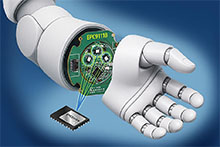 In robotics, GaN’s advantages are equally clear. From humanoid robots to warehouse automation and surgical systems, every reduction in size and weight translates directly into better performance and battery life. A humanoid robot can have around 40 motors and with GaN, each motor drive can be smaller, lighter, and more precise.
Humanoid and service robots represent the most technically demanding and rapidly advancing applications, where investment and technology development are moving fastest. These apex designs will, over time, cascade into smaller and lower-cost platforms such as drones, e-bikes, and power tools.
Space: The Ultimate Test for Reliability
 Beyond AI and robotics, space systems continue to be one of the most compelling use cases for GaN. Satellites demand extremely efficient, lightweight power systems that can withstand harsh radiation environments for decades. In orbit, watts per kilogram define value.
GaN’s material properties make it inherently more robust than silicon. The strong gallium–nitrogen bond and absence of gate oxides mean GaN devices can withstand radiation levels far beyond those tolerated by CMOS or MOSFET technologies. EPC’s space-qualified GaN FETs and ICs have been tested to over 100 megarads with no degradation, compared to typical silicon devices that fail around 30 kilorads.
For satellite manufacturers, this means fewer shielding requirements, simpler redundancy strategies, and higher payload capacity — all translating to lower launch and operating costs.
Expanding into Low-Voltage Applications
EPC’s latest devices are pushing GaN performance deeper into the low-voltage domain, now covering down to 15 V. The 40 V to 15 V range represents the largest segment of the transistor market — powering everything from battery-operated devices to point-of-load converters. At these voltages, performance determines success, and GaN’s superior efficiency and high-frequency switching allow designers to dramatically reduce system size while improving thermal behavior.
As GaN devices become more accessible at lower voltages, they can replace silicon MOSFETs in everything from USB-PD chargers to AI edge systems to precision motor drives, accelerating adoption across both industrial and consumer markets.
The Next Wave: Integration and Intelligence
Looking ahead, integration will define the next era of GaN innovation.
EPC’s latest GaN ICs already combine power FETs and gate drivers in single, high-performance packages. The next step is adding control and protection functions, creating fully integrated GaN power stages that simplify design and further reduce system footprint.
Integration not only improves performance but also lowers bill-of-materials cost, enabling scalable, efficient solutions that reach into high-volume markets.
Powering What’s Next with GaN
From AI servers and humanoid robots to satellites in orbit, GaN technology is redefining what’s possible in power conversion. EPC continues to lead this transformation with devices that deliver higher efficiency, smaller size, and smarter integration across every application.