Rethinking Power: GaN Innovation for Data Centers and Humanoid
GaN Talk – Maurizio Di Paolo Emilio
Jan 13, 2026
At the Bodo Power Systems Wide Band Gap Forum in Monaco, EPC founder and CEO Alex Lidow set the tone for the GaN discussion, highlighting the significant advantage of gallium nitride (GaN) by drawing on fifty years of experience in power semiconductors. Speaking alongside experts from Texas Instruments, Navitas, Infineon, Toshiba, Volkswagen, and Mitsubishi, he positioned GaN as the superior choice for low-voltage, high-frequency systems—from AI data centers and humanoid robots to autonomous vehicles and LiDAR. While SiC remains the go-to for high voltages, Lidow highlighted GaN as the cost-effective technology already reshaping point-of-load power—and much more.
Lidow pointed out GaN's key cost crossover, saying that EPC first predicted silicon parity in 2014 and reached it by 2015. He talked about the "die-size magic": GaN devices are about ten times smaller than silicon MOSFETs of the same type. This makes wafers more expensive, but the end products are cheaper overall. This feature made it possible for many people to use it almost 10 years ago, especially in low-voltage areas that required high performance.
Lidow noted that the first 100 V GaN devices were introduced 20 years ago because that’s where customers initially needed faster, smaller solutions. That strategy still holds: "With our seventh generation, we're now deep into point-of-load converters, running at higher megahertz. And market sizes grow as you move to lower voltages." He highlighted 48 V data center backplanes as one of the fastest-growing opportunities.
On device architectures, Lidow confirmed low-voltage consolidation around enhancement-mode (e-mode) GaN: power switching now favors monolithic e-mode designs, streamlining integration versus cascodes or direct drives at higher voltages.
Lidow reflected on EPC’s packaging journey, noting that early chip-scale devices delivered ultra-low inductance, low resistance, and excellent thermal performance - but their fragility and stiff terminals ultimately limited adoption. These problems were fixed by switching to PQFN packages. The tight internal layouts keep parasitics low, the backside has strong thermal paths, and the package itself now absorbs the thermal-mechanical stresses that are the only real wear-out mode for wide-bandgap.
According to Lidow, solid thermal-mechanical design is ultimately what determines the reliability of wide-bandgap devices. When properly designed, GaN's strong atomic bonds make it very effective at handling overloads, and superior manufacturing minimizes external defects. He linked these traits to significant technological developments, noting that GaN's growing societal influence is evident in its role in enabling LiDAR, powering AI infrastructure, and operating robot motors.
Lidow highlighted everyone with a data center solution showing an 800V-to-12V, 6kW converter that was only 8 mm thick and had 98% efficiency, achieved by interleaved eight-level GaN at megahertz speeds. It is easier to connect multiple inductors in parallel with voltage-sharing topologies. Series connections work better for higher voltages, and parallel connections work better for power scaling. He told people to rethink old designs for this new stacking method.
He emphasized GaN's maturity by pointing out that seventh-generation devices can handle 1.8 million amps per square millimeter, more than copper can, and require new ways of thinking about systems. Panelists agreed that as AI pushes power systems toward megawatt-scale, GaN remains unmatched in low-power-density domains. With cost parity emerging and rack-level efficiency gains in sight, Lidow sees GaN on an accelerating, unstoppable trajectory (figure 1).
 Figure 1: Panel Discussion Speakers
GaN Power Stages Drive the Next Generation of Humanoid Robotics
As AI and autonomous systems push the limits of technology, a new type of machine is being developed: humanoid robots that can move in ways that look alive. GaN is providing the small, powerful power sources that these systems require.
Alex Lidow, CEO of EPC, spoke at the keynote during the Bodo event in Munich and said that GaN is a key part of the robotics revolution. "In twenty years, we'll look back on this time and call it the era of AI and robotics. GaN really shines when it comes to performance," he said.
According to various analysts, the humanoid robot market is expected to grow in the coming years, driven by a demand for computing and power electronics technology capable of meeting increasingly advanced levels of integration and efficiency. With the aging of society and declining birth rates, particularly in developed countries, the need for automated labor is becoming increasingly pressing. Humanoid robots are emerging as a practical solution to labor shortages in industrial and service sectors. Currently, the limiting factor is cost, as well as design challenges that involve not only hardware but also software, including programming, adaptation, and the ability to learn from various unexpected situations. Overcoming these challenges will allow society to integrate robots into everyday life and work.
The motor is what gives every robot its power electronics. These are brushless DC (BLDC) motors that power different parts of the body. A typical robot has more than 40 motors, each of which powers a different part, like its fingers, knees, and so on. The amount of energy these motors need depends on what they do. These advances are made possible by advanced power electronics that are very efficient, small, and dependable. This is where GaN power transistors and integrated circuits (ICs) come in.
According to a 2025 Bank of America report cited in industry analysis, annual humanoid robot sales could reach 1 million units by 2030, scaling to a staggering 3 billion robots in service by 2060—nearly one for every three humans on the planet. This explosive growth aligns with Goldman Sachs projections of a $38 billion global humanoid market by 2035, potentially deploying 3–27 million units worldwide, particularly for hazardous tasks that protect human workers. Driven by aging populations, labor shortages, and AI advancements, these forecasts underscore the mounting demand for versatile humanoid platforms in industrial, service, and consumer applications.
GaN will help make systems smaller, lose less power, and work better in extreme temperatures. Gallium nitride is mostly used in humanoid robots for rotary actuators, dexterous hands, linear actuators, intelligent perception, AI and control systems, batteries, and chargers. The newest GaN power ICs have FETs, drivers, and protection built in. This makes it easier to design plug-and-play actuator modules for robotic arms and hands, which is hard to do with separate MOSFETs.
GaN Advantages in Modern Motor Drive Architectures
Most humanoid robots rely on brushless DC (BLDC) motors operating at around 48-60 volts—an ideal range for GaN’s capabilities. These motors must deliver high torque and quick response while minimizing weight and heat.
Traditional silicon MOSFETs, while robust, become limiting at these voltages because of higher switching losses and body‑diode reverse recovery. In a MOSFET‑based drive, the control dead time inserted between complementary switches prevents shoot‑through but also increases distortion and losses because the body diode or channel conduction dominates during that interval. In MOSFET-based motor drives, extending dead time is often assumed to reduce diode-related losses. In reality, reverse recovery is not prevented by longer dead times: it occurs after the dead time interval and only during hard-switching transitions, depending on the direction of motor current during phase commutation. This results in unnecessary body-diode conduction during dead time, increasing losses and reducing efficiency. In typical designs, dead time can consume up to 6% of the AC cycle.
Because GaN devices combine zero reverse recovery with very fast switching, designers can safely minimize dead time to just a few tens of nanoseconds, sharply reducing dead‑time‑related distortion and losses while still preventing shoot‑through. Operating BLDC motors at frequencies up to 100 kHz, rather than the traditional 20 kHz limit, yields measurable gains in torque response, size reduction, and reliability.
From Electrolytics to Ceramics
One of the less-obvious benefits of high-frequency operation is that it allows you to replace large, unreliable electrolytic capacitors with small, reliable ceramic ones. Electrolytic capacitors break down when the temperature rises and can fail when shaken or subjected to mechanical stress, which is common in mobile robots. GaN enables higher-frequency switching, allowing engineers to design drives that are smaller, lighter, and more durable and that perform better in high-temperature environments.
Evolution of GaN Power Modules
EPC started in this field by making chip-scale GaN half-bridge modules for people just starting to use robots. Their success led to a second generation, which came in a package (QFN) that made it easier to use and kept the heat under control better. Lidow said, "Most motor drive applications are lower volume and engineering-intensive," and engineers don't like chip-scale devices because they are hard to work with.
As engineers began using these modules in robotic actuators, such as arms, shoulders, and wrists, the combination of performance and usefulness led to their widespread adoption. In fact, many humanoid designs today use GaN-based drives for their limb motors. These drives are often smaller than the MOSFET boards they replace, yet they deliver the same or more power.
EPC built on that success by developing three-phase packages with three half-bridges in a single, thermally efficient case. This setup is like the standard three-phase design for brushless DC motors, which makes the board smaller and the design easier. The device's back is at ground potential, so heat sinks can be mounted directly without insulation layers. This arrangement makes the device even more thermally efficient (Figure 2).
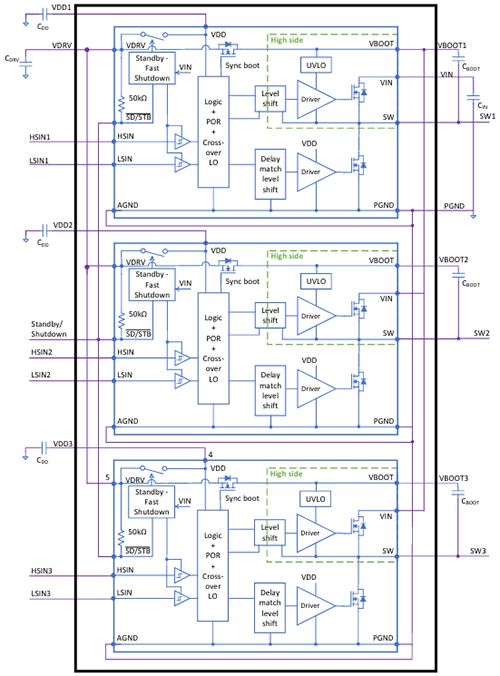 Figure 2: EPC33110 block diagram
The EPC33110 is a high-performance three-phase motor drive module built with monolithic GaN half-bridges and an integrated gate driver, designed for BLDC motors in drones, robotics, and humanoid systems. It supports up to 80 V input, with a very low 8.7 mΩ typical RDS(on) per GaN FET, enabling high efficiency and fast switching. Logic-level inputs (3.3 V / 5 V compatible) simplify control. The compact 6 × 6.5 mm QFN package provides excellent thermal performance and high power density. The module supports PWM up to 100 kHz and can deliver up to 20 ARMS per phase, reducing system size and weight while improving dynamic response.
Toward Monolithic Motor Drive Integration
If GaN's first packages were a big step forward in system density, the next generation takes integration to the next level. EPC's third-generation devices, which will come out in 2026, use the company's newest GaN FET technology to fit more features into smaller spaces.
Each module is only 3 × 3 mm in size, yet it can handle up to 35 A and includes built-in safety features such as over-current and over-temperature protection, shoot-through prevention, and low quiescent current operation. The die's direct thermal connection to the package substrate ensures that heat can be removed quickly, even at high power density.
The next big step, called "Trinity," integrates all three motor phases onto a single GaN chip. This means the motor drive is in a single small package that only needs to be connected to a controller and sensors. Initial tests in EPC's lab indicate that this architecture can control several robotic axes from a board that is smaller than a credit card (figure 3).
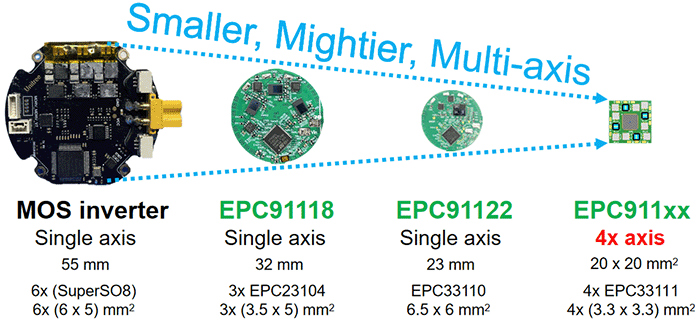 Figure 3: EPC’s ICs Evolution. The third generation will come out in May-July 2026.
Scaling Innovation Across Applications
Although designed for humanoid and collaborative robots, the same technology naturally extends to other battery-powered systems. Lightweight, high-efficiency GaN drives are equally valuable in drones, e-bikes, and precision industrial automation. The advantages—smaller form factor, higher efficiency, and longer lifetime—translate directly across these platforms.
EPC’s modular development path illustrates how GaN innovation cascades down from cutting-edge robotics to broader markets. “You pick the top of the pyramid and develop something really good for that,” Lidow concluded, “and eventually it starts trickling down to all the other DC motor applications.”
Enabling the Performance Era
As systems become faster, more flexible, and more autonomous, their power stages must evolve accordingly. GaN devices can switch an order of magnitude faster than comparable silicon MOSFETs, enabling higher operating frequencies that reduce losses and improve overall system efficiency. This high‑speed capability also permits the replacement of bulky electrolytic capacitors with small, reliable ceramic devices, reducing weight and improving robustness in compact humanoid and drone platforms. Moreover, GaN’s zero reverse recovery charge eliminates the body‑diode recovery losses and associated thermal stress and allows dead times to be reduced from hundreds of nanoseconds to just a few nanoseconds, which cuts distortion, increases torque per ampere, and lowers acoustic noise. GaN stands out as the semiconductor technology of choice powering the next generation of motion—from humanoid robot joints to drone propulsion systems
This article appears on EE Power.