EPC’s Seventh-Generation GaN Expands into Low-Voltage Power for AI and Robotics
GaN Talk – Maurizio Di Paolo Emilio
Feb 02, 2026
In an interview with Judith Cheng, Editor at Large at MakerPROTW, Alex Lidow, co-founder and CEO of Efficient Power Conversion (EPC), described the company’s seventh-generation gallium nitride (GaN) technology, now in mass production, and its implications for low-voltage applications that have traditionally been dominated by silicon MOSFETs. With devices such as the 40 V EPC2366 already in volume production, EPC is positioning GaN as a mainstream option for 40 V and below - a market that exceeds the size of the 100 V segment where GaN first gained traction.
Speaking with Judith Cheng, Lidow emphasized the milestone significance of this generation: “This generation marks a very important step for us,” Lidow said. “For the first time, designers working at 40 volts and below can get significantly better performance from GaN than from MOSFETs.”
 Alex Lidow, EPC, CEO
 Judith Cheng, MakerProTW, Editor at Large
Moving GaN into the Low-Voltage Mainstream
Until recently, GaN’s advantages were most clearly expressed at higher voltages, typically above 40 V, where fast switching and low losses delivered compelling gains in efficiency and power density. Below 40 V, however, silicon MOSFETs remained highly competitive, limiting GaN adoption.
“With all prior generations, the practical limit was just above 40 volts,” Lidow said. “At that point, MOSFETs could still compete very well on both performance and cost. Seventh-generation GaN removes that barrier.”
By enabling efficient operation at 40 V, 25 V, 15 V and lower, EPC is addressing applications such as point-of-load converters and low-voltage rails in computing systems - areas that are both performance-critical and highly sensitive to size, efficiency and thermal constraints.
“The low-voltage market is not a commodity market,” Lidow added during the interview. “It’s about performance, density and efficiency, and that’s where GaN now has a clear advantage.”
Impact on AI Server Power Architectures
One of the most immediate applications for EPC’s Gen-7 devices is in AI data centers. Modern AI servers already rely heavily on GaN at higher voltages, particularly in the 48 V distribution stage. The remaining opportunity lies closer to the load, where 12 V rails are still commonly implemented with MOSFETs.
When asked by Judith Cheng about AI applications, Lidow highlighted the efficiency gains:
“In most AI systems today, power already flows through our 100-volt GaN devices in the 48-to-12-volt conversion stage,” he said. “What changes now is the output side. With 40-volt Gen-7 devices, designers can replace MOSFETs at 12 volts and achieve much higher power density.”
As AI accelerators continue to increase in power and complexity, power delivery has become a limiting factor. New architectures - ranging from 800 V distribution down through multiple intermediate voltages - are being explored to reduce losses and manage heat.
“These systems are constrained by both energy consumption and physical size,” Lidow explained to MakePro. “That makes power conversion and thermal management absolutely critical. GaN is clearly the best technology for that challenge.”
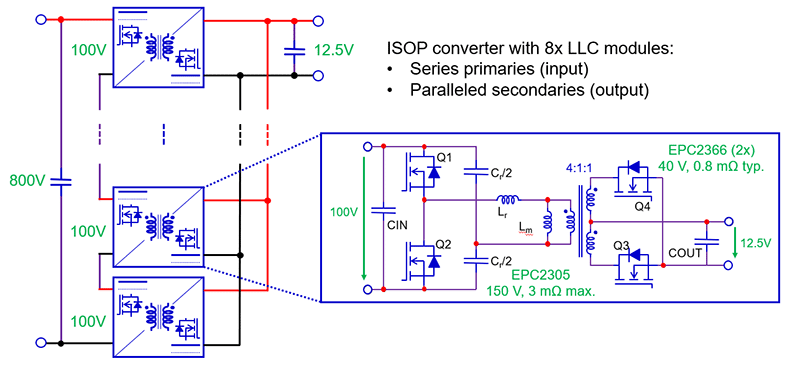 Figure 1: ISOP Block Diagram
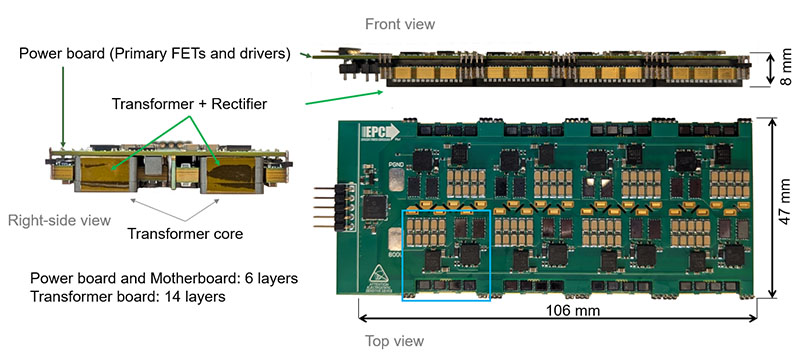 Figure 2: 800V to 12.5V Board
Enabling Physical AI and Robotics
Beyond data centers, EPC sees strong momentum in robotics and so-called physical AI. Many advanced robots, including humanoid systems, operate from a 48 V DC bus, creating close alignment with server power architectures.
During the interview with Judith Cheng, Lidow described the robotics impact:
“A robot is essentially a collection of motors, sensors and an AI brain,” he said. “GaN improves all of those elements.”
In motor-drive applications, GaN’s ability to operate efficiently at higher switching frequencies enables designers to reduce or eliminate bulky passive components, particularly electrolytic capacitors. This leads to smaller, lighter and more reliable systems - key requirements for mobile robots.
“When you can run motors at 100 kHz instead of tens of kilohertz, the motor becomes smoother, more efficient and longer-lasting,” Lidow added. “That’s why GaN is becoming the obvious choice in robotics.”
Some advanced humanoid robots already incorporate hundreds of GaN devices per system, spanning motor drives, DC-DC converters and auxiliary power rails.
Relevance for Automotive Electrification
Automotive electrification represents another major growth area, particularly as vehicles transition toward 48 V and 800 V electrical architectures. EPC already offers automotive-qualified GaN devices at higher voltages, and Gen-7 low-voltage parts are expected to follow.
Speaking to Judith Cheng, Lidow clarified the automotive roadmap: “Gen 7 devices are not automotive-qualified yet, but they will be,” he said. “That process takes time, but it aligns well with automotive design cycles.”
The appeal of 48 V systems lies in their ability to deliver higher power while remaining below the 60 V safety threshold, avoiding additional insulation and shock-protection requirements. In this context, 40 V GaN devices play a key role in converting 48 V rails down to legacy 12 V systems.
“This is exactly where devices like the EPC2366 fit,” Lidow told MakePro. “They enable efficient 48-to-12-volt conversion using GaN throughout the system.”
Taiwan’s Role in Semiconductor and AI Trends
Asked by Judith Cheng about Taiwan’s role in AI and robotics, Lidow emphasized the country’s strategic importance: “Certainly, all of our manufacturing is in Taiwan, and Taiwan is today the best place in the world to build a semiconductor,” he said. “Taiwan has incredible infrastructure and talent that goes back several academic generations. There is no place with greater skills in semiconductors than Taiwan.”
He also highlighted Taiwan’s contributions beyond chips: “Taiwan is a very important center for DC-DC converters. Companies like Delta Electronics, Lite-On and AcBel are all leaders. Taiwan powers AI systems and makes the chips as well. It’s also a center of excellence in electric bikes, which are part of the motor control ecosystem.”
Lidow noted that while Taiwan excels in components and subsystems, full humanoid robot systems remain primarily in the US, China, and Japan. Nevertheless, he sees Taiwan as a critical provider of advanced modules and components that underpin emerging robotics and physical AI trends.
Ecosystem, Education and Adoption
As new applications such as robotics remain relatively unstandardized, EPC places strong emphasis on ecosystem support and customer education. Each new device is accompanied by evaluation boards, while more application-specific reference designs provide complete system-level guidance.
“We focus on designs that are broadly applicable,” Lidow explained during the MakePro interview. “That requires close collaboration with what we call teaching customers -companies that are defining the next generation of systems.”
In parallel, EPC continues to invest in education through technical papers, tutorials and a peer-reviewed GaN power design textbook published by Wiley and used in universities worldwide.
Looking Forward
With seventh-generation GaN now in production, EPC sees low-voltage power conversion as the next major frontier for GaN adoption.
“Gen-7 doesn’t just make existing GaN devices better,” Lidow concluded in the interview with Judith Cheng. “It opens up an entirely new part of the market where GaN was not yet competitive. And that has implications across AI, robotics, automotive and many other applications.”